Blog

Categories
Blog

Hybrid Cloud: A Smarter Way to Scale Your Business

Hybrid Cloud A Smarter Way to Scale Your Business

Growth has a way of exposing technology limitations that were easy to overlook before. Servers start reaching capacity. Storage becomes harder to manage. Applications that once worked well for a smaller team begin struggling to keep up. New locations, employees, and security requirements put additional pressure on infrastructure that may have been designed for a very different version of the business.

When that happens, moving everything to the cloud can sound like the obvious next step. But for most growing businesses, the better question is not, “Should we move to the cloud?” It is, “Where should each workload run to best support the business?”

That is where a hybrid cloud strategy becomes valuable. By combining on-premises infrastructure, private cloud, and public cloud resources, businesses have more flexibility to decide where applications and data belong based on performance, security, availability, dependencies, and cost.

For small and midsize businesses, that can create a more practical path to modernization. Instead of forcing an all-or-nothing cloud migration, you can keep what still works, move what makes sense, and build an infrastructure strategy around what the business needs next.

What Does Hybrid Cloud Actually Mean?

Hybrid cloud brings different computing environments together as part of a larger technology strategy. The National Institute of Standards and Technology defines a hybrid cloud as an infrastructure composed of two or more distinct cloud environments that remain separate but are connected in ways that enable data and application portability.

In practice, a business might keep certain legacy or business-critical applications on-premises, use private cloud resources for workloads that require dedicated infrastructure or greater control, and use a public cloud platform such as Microsoft Azure for applications that benefit from scalability and flexibility.

The key is that there is no single environment that is automatically right for every workload. An application with strict latency requirements may make sense on-premises. A sensitive workload may need tighter controls or dedicated resources. Another application may benefit from the ability to scale cloud resources as demand changes.

The goal is not to use as much cloud as possible. It is to make better decisions about where technology should run.

When Growth Starts Outpacing Your Infrastructure

A business can outgrow its technology long before a server actually fails. The signs tend to appear gradually. Capacity gets tighter, hardware refreshes become more frequent, applications become harder to support, and expansion starts requiring more infrastructure than expected.

At the same time, keeping aging hardware in place can create its own challenges. Older infrastructure may be more difficult to scale, increasingly expensive to maintain, or unable to support the applications and security capabilities the business wants to adopt next.

This is where hybrid cloud provides more options. Instead of treating every capacity problem as another hardware purchase, businesses can evaluate whether a workload should remain where it is, move to a cloud environment, or be modernized in a different way.

Sometimes moving infrastructure to Azure is the right answer. Sometimes refreshing an on-premises environment makes more sense. In other cases, the application itself may need to be modernized before changing where it runs.

The important part is starting with the business need rather than the technology trend.

Modernize With a Reason Behind It

Cloud migration should solve a problem.

That problem might be aging infrastructure, limited capacity, a need for greater resilience, changing workforce requirements, or difficulty supporting growth. A business may already be using cloud resources but have little visibility into what those resources cost or whether they are being used efficiently.

Each situation calls for a different response.

Microsoft’s Cloud Adoption Framework recommends identifying the business driver behind a migration and selecting a strategy for each workload accordingly. A workload might be retained in its current environment, moved with minimal changes, modernized, rebuilt, replaced, or retired altogether.

That workload-by-workload approach helps keep cloud projects tied to business outcomes. Instead of asking how much infrastructure can be moved, businesses can ask what needs to change, why it needs to change, and which option creates the most value without introducing unnecessary complexity.

For a growing company, that is a much more useful way to think about modernization.

Build Security Into the Strategy From the Beginning

Moving an application to the cloud does not automatically make it secure. Cloud platforms provide extensive security capabilities, but those tools still need to be designed, configured, monitored, and managed appropriately.

Identity and access, network architecture, data protection, monitoring, recovery, governance, and clearly defined responsibilities all need to be considered as part of the broader cloud strategy.

Microsoft recommends integrating security considerations throughout cloud adoption planning, particularly when legacy workloads are being updated for cloud infrastructure. That includes planning for areas such as confidentiality, integrity, availability, incident response, and the long-term maintenance of the organization’s security posture.

For small and midsize businesses, this means answering important questions before a workload moves. Where does sensitive data reside? Who should have access to it? What compliance requirements apply? How will the system be monitored? What happens if it becomes unavailable? Who will be responsible for the environment after the migration is complete?

Answering those questions early can prevent security and governance from becoming problems that need to be fixed later.

A Successful Migration Starts Before Anything Moves

Cloud migration is rarely as simple as copying a server from one location to another. Business applications often depend on databases, identity systems, networks, APIs, file shares, and other services. Moving one component without understanding those relationships can create disruptions somewhere else.

That is why discovery and planning matter so much.

Microsoft recommends documenting both the business and technical details of workloads before migration, including criticality, data sensitivity, performance requirements, architecture, dependencies, security requirements, recovery objectives, and operating constraints. For larger migrations, Microsoft also recommends grouping related workloads into migration waves so connected systems can be moved together and lessons from earlier migrations can improve the ones that follow.

For the business, the goal is not simply to complete the migration. It is to make the transition with as little operational disruption as possible.

Before moving a critical workload, there should be a clear understanding of what depends on it, how much downtime the business can tolerate, how the new environment will be tested, and what happens if the migration does not go as planned.

The more uneventful the migration feels to employees and customers, the better.

Cloud Optimization Starts After the Migration

Migration is an important milestone, but it is not the finish line.

Cloud environments change constantly. Applications grow, storage requirements increase, new services are added, and business priorities shift. Resources that were appropriately sized when they were deployed may become underused or constrained later.

That flexibility is one of the biggest benefits of cloud infrastructure, but it can also create unnecessary spending and complexity if no one is regularly reviewing the environment.

Microsoft recommends ongoing workload reviews across cost, performance, reliability, security, and operational excellence. This is particularly important in hybrid environments, where dependencies between cloud and on-premises systems can introduce additional complexity.

For businesses, optimization can include reviewing utilization, right-sizing cloud resources, monitoring performance, managing access, improving governance, testing recovery procedures, and periodically asking whether workloads are still running in the right place.

Cloud optimization is not simply about lowering the monthly bill. It is about making sure the environment continues to support the business as efficiently and reliably as possible.

How WorkSmart Helps Build the Right Hybrid Cloud Environment

WorkSmart takes a business-first approach to hybrid cloud. Instead of starting with the assumption that everything belongs in the cloud, we help evaluate your applications, infrastructure, dependencies, security requirements, business priorities, and costs to determine where each workload makes the most sense.

That may mean keeping a business-critical or legacy system on-premises, using private cloud for workloads that require dedicated resources or greater control, or moving scalable workloads to public cloud infrastructure such as Microsoft Azure. When Azure is the right fit, WorkSmart can help plan workload migration, architecture, capacity, connectivity, and the transition from existing infrastructure.

The same approach applies to environments that are already in the cloud. WorkSmart helps identify underused resources, right-sizing opportunities, unnecessary spend, and architecture decisions that may be limiting performance or efficiency.

The goal is not cloud for the sake of cloud. It is a technology environment that supports where the business is going.

Right workload. Right environment. Right cost.

If your servers are approaching replacement, cloud costs are difficult to explain, or you are simply unsure what should move and what should stay, a Hybrid Cloud & Workflow Assessment can provide a clearer picture of your current environment and a practical roadmap for what comes next.

Schedule a Cloud Strategy Consultation with WorkSmart.


Sources

National Institute of Standards and Technology, The NIST Definition of Cloud Computing, Special Publication 800-145
https://nvlpubs.nist.gov/nistpubs/Legacy/SP/nistspecialpublication800-145.pdf

Microsoft, Select Your Cloud Migration Strategies
https://learn.microsoft.com/en-us/azure/cloud-adoption-framework/plan/select-cloud-migration-strategy

Microsoft, Cloud Adoption Plan Template for Migration
https://learn.microsoft.com/en-us/azure/cloud-adoption-framework/plan/migration-adoption-plan

Microsoft, Migration Wave Planning
https://learn.microsoft.com/en-us/azure/cloud-adoption-framework/migrate/migration-wave-planning

Microsoft, Plan for a Secure Cloud Adoption
https://learn.microsoft.com/en-us/azure/cloud-adoption-framework/secure/plan

Microsoft, Optimize Workloads After Migration
https://learn.microsoft.com/en-us/azure/cloud-adoption-framework/migrate/optimize-workloads-after-migration
 

Categories
Blog

AI Readiness Assessment: What to Evaluate Before You Invest

AI Readiness Assessment What to Evaluate Before You Invest

AI interest often starts with a tool. Someone sees what Microsoft Copilot can do, a department starts experimenting with ChatGPT, or leadership begins asking where AI could reduce costs or improve productivity. Before long, the conversation shifts to a bigger question: What should we invest in?

That may be the wrong question to ask first. Before choosing a platform, buying licenses, or launching a pilot, businesses need to understand where AI can actually improve the work and whether the organization is ready to support it. That is the purpose of an AI readiness assessment.

An AI readiness assessment helps leadership identify where AI can create meaningful value, where gaps or unmanaged risks could get in the way, and what should happen next. The goal is not to give the business a simple “ready” or “not ready” label. The goal is to create direction.

What Is an AI Readiness Assessment? 

An AI readiness assessment evaluates the conditions that will determine whether an AI initiative can succeed. That includes the business problem, the workflow, data, technology, security, governance, people, and how success will be measured.

That scope is much broader than asking whether your technology can technically support an AI application. Microsoft takes a similarly broad view in its current AI adoption guidance, evaluating areas such as business strategy and value, AI governance and security, technology and data, and organization and culture.

The takeaway is straightforward: AI readiness is a business issue as much as it is a technology issue. Before making a significant AI investment, organizations need to understand whether the business, the workflow, and the underlying environment are ready to support it.

AI readiness is a business issue as much as it is a technology issue. 

Here is what businesses should evaluate before making a significant AI investment. 


1. Start With the Work

Before asking what AI can do, start by asking what the business needs to do better. Look for places where employees are losing time, handoffs are slowing down work, information is difficult to find, or teams are repeating manual tasks that add little value.

Those problems are better starting points for AI than a list of available tools. “We want to use AI” is not a business case. “Account managers spend hours gathering information from different systems before customer meetings” is. Once the problem is clear, you can decide whether AI is actually the right solution.

Sometimes it will be. Other times, a workflow change, integration, or simpler automation may solve the problem more effectively. AI should earn its place in the workflow.


2. Establish Your Readiness Baseline

Next, look at the organization as it operates today. A useful readiness baseline should consider people, process, data, and technology, because each of those areas can affect whether a proposed AI use case succeeds.

Are important workflows documented? Is the information employees need accessible and reliable? Do employees understand how AI should and should not be used? Is someone accountable for AI decisions? These questions often reveal more about readiness than whether the organization has the latest technology.

A business can have a modern technology environment and still be unprepared for a particular AI use case. Readiness depends on what you are trying to accomplish, not whether the entire organization can be reduced to one company-wide score.


3. Determine Whether Your Data Can Support the Use Case

AI needs information to work with, so data readiness is a critical part of the assessment. Before connecting an AI system to business information, you need to understand what that data is, where it lives, who owns it, and who should be able to access it.

For each potential use case, determine whether the required information is accurate and current, who owns it, who currently has access, and whether it contains confidential, customer, employee, regulated, or proprietary information. You should also consider whether existing permissions make sense for the way the AI system will use that data.

The U.S. Government Accountability Office includes data as one of four core principles in its AI Accountability Framework, alongside governance, performance, and monitoring. That does not mean a business needs perfect data across the entire organization before using AI. It does mean the data needs to be good enough—and appropriately controlled—for the specific problem you are trying to solve.


4. Understand How Employees Are Already Using AI

For many businesses, AI adoption has already started, even if leadership has not formally approved an AI strategy. Employees may be using generative AI to write, summarize, research, analyze, troubleshoot, or complete other day-to-day work.

Some of that use may be approved. Some may be shadow AI: tools being used for work without the organization’s knowledge, review, or established guardrails. An AI readiness assessment should help leadership understand both.

The goal is not to shut down useful experimentation. It is to gain visibility into which tools employees are using, what they are using them for, what information they are entering, and whether there is a consistent process for approving new AI applications. If employees do not have clear guidance, they are making those decisions individually. That creates unnecessary risk and usually signals that governance needs to catch up with adoption.


5. Identify the AI Opportunities Worth Pursuing

Once you understand the work, the data, and the current environment, you can begin identifying and prioritizing AI opportunities. Potential use cases may include internal knowledge search, repetitive administrative work, service workflows, analysis, decision support, or automation across well-defined processes.

The strongest first use case is not always the most impressive one. It is usually the opportunity where the business problem is meaningful, the workflow is understood, the required data is available, the risk is manageable, someone owns the outcome, and success can be measured.

That distinction matters. The objective is not to deploy more AI. The objective is to improve the business.


6. Decide How You Will Measure Value

AI activity and AI value are not the same thing. Buying licenses is activity. User adoption is important, but it still does not tell leadership whether the investment improved the business.

Before launching an AI initiative, define what success should look like. Depending on the use case, that may mean reducing cycle time, rework, response time, backlogs, errors, or employee effort. It may also mean improving throughput, consistency, customer experience, access to information, or decision speed.

Microsoft’s AI adoption guidance similarly emphasizes defining success criteria and connecting AI initiatives to measurable business outcomes. Those measures should be established before the pilot begins. Otherwise, a company may finish an AI project knowing that people used the tool without knowing whether the investment actually produced value.


7. Put Practical AI Governance in Place

Good governance should make responsible AI adoption easier, not turn every idea into an approval marathon. For a midsize business, that starts with clear ownership and clear boundaries.

Leadership should know who approves new AI tools, what information employees can enter into them, how vendors are reviewed, when human oversight is required, and what security, privacy, contractual, or compliance requirements apply. The organization should also know what happens when an AI system produces an incorrect, inappropriate, or unexpected result.

The National Institute of Standards and Technology organizes its AI Risk Management Framework around four functions: Govern, Map, Measure, and Manage. NIST also treats AI risk management as an ongoing activity throughout the AI lifecycle.

That is the useful mindset for businesses. An AI policy is not the finish line. Tools change, employees find new uses, and vendors add new capabilities. Governance needs to evolve with them.


8. Turn Readiness Into a Roadmap

An AI readiness assessment should not end with a list of observations. Leadership should leave with a clear understanding of what should happen next.

That may mean establishing an acceptable-use policy, addressing shadow AI, improving access controls, documenting a workflow, assigning ownership, preparing data, training employees, or selecting a focused pilot. Some actions can happen immediately, while others may need to wait until the business is better prepared.

That is the value of a phased roadmap: you do not have to solve everything before you start, and you do not have to invest everywhere at once. You can prioritize the opportunities that make the most sense now and build from there.

When Does an AI Readiness Assessment Make Sense? 

An assessment can be especially useful when leadership wants an AI strategy but does not have a clear starting point, employees are already using AI without consistent guidance, or different departments are evaluating different tools. It can also help when the organization has already purchased AI capabilities but value remains unclear, or when security, data, privacy, or integration concerns are slowing decisions.

These are not signs that the organization is behind. They are signs that AI interest has reached the point where scattered experimentation needs direction.

Build an AI Roadmap Around the Work That Matters 

AI does not need to be everywhere in your business to create value. It needs to be in the right places.

WorkSmart’s AI Readiness Assessment helps leadership understand where those places are. We evaluate readiness across people, process, data, technology, and governance. We identify current and shadow AI use, uncover high-value opportunities, prioritize investments around measurable business value, and surface the gaps that need to be addressed for responsible adoption.

From there, we build a phased roadmap for what should happen now, what should come next, and what may not be worth pursuing yet. Because the goal is not to buy more AI. It is to make better decisions about where AI can improve the business.

If your team is exploring AI but does not have a clear starting point, WorkSmart can help you identify where AI fits, where it does not, and what to do next.

Explore WorkSmart’s AI Services or request an AI Assessment to start building a practical roadmap around the work that matters.


Sources 

  1. Microsoft Learn, Introduction to the Agentic AI Adoption Maturity Model
    https://learn.microsoft.com/en-us/agents/adoption-maturity-model/
  2. Microsoft Learn, Agentic AI Maturity Model — Business Strategy
    https://learn.microsoft.com/en-us/agents/adoption-maturity-model/maturity-model-business-process
  3. Microsoft Learn, Agentic AI Maturity Model — AI Governance and Security
    https://learn.microsoft.com/en-us/agents/adoption-maturity-model/maturity-model-security-governance
  4. National Institute of Standards and Technology, AI Risk Management Framework Core https://airc.nist.gov/airmf-resources/airmf/5-sec-core/
  5. National Institute of Standards and Technology, AI RMF Playbook https://www.nist.gov/itl/ai-risk-management-framework/nist-ai-rmf-playbook
  6. U.S. Government Accountability Office, Artificial Intelligence: An Accountability Framework for Federal Agencies and Other Entities https://www.gao.gov/products/gao-21-519sp
Categories
Blog

IT Advisory vs. Managed IT Services: Which Does Your Business Actually Need?

IT Advisory vs. Managed IT Services worksmart

When your business needs better technology support, the choice isn’t always as simple as picking an IT provider and signing a contract.

The real question is: What problem are you trying to solve?

Some businesses need someone to help determine where their technology should go. Others need dependable day-to-day support to keep systems running. And as a business grows, it may need both.

Understanding the difference between IT advisory services and managed IT services can help you spend your technology budget where it will actually make a difference.

What Managed IT Services Cover

Managed IT services are the operational side of technology: the ongoing work of keeping your systems healthy so your team can do their jobs.

A managed services agreement typically covers help desk support when employees run into problems, monitoring that catches issues before they become outages, patching and updates that close security holes, backup management, and vendor coordination so you’re not the one stuck on hold with the internet provider.

Most providers charge a flat monthly fee, which turns IT support from an unpredictable expense into a known number.

The best managed services work is often invisible. Systems stay up, threats get blocked, and the quiet weeks are evidence that the technology is being maintained properly.

That maintenance matters. The U.S. Small Business Administration points out that smaller businesses can be attractive targets for cyberattacks because they often lack the staff and time to keep protections current. Managed services exist to close that gap continuously, not just once a year.

The Real Difference: Direction vs. Operation

A useful way to understand the distinction is to compare IT to your finances.

Managed IT services are like your accounting function: transactions get processed, the books stay accurate, and payroll goes out on time.

IT advisory is more like having a CFO: someone looking ahead at cash flow, investments, and risk and helping you understand what the numbers mean for where the business is going.

You wouldn’t expect a bookkeeper to set your growth strategy, and you wouldn’t hire a CFO to process every invoice.

The same logic applies to technology.

IT Advisory Managed IT Services
Core question Where should our technology go? Is everything running and secure?
Time horizon One to three years ahead Right now, every day
Typical deliverables Roadmaps, budgets, risk assessments, executive reporting Resolved tickets, patched systems, verified backups
Who you work with A vCIO or senior advisor Help desk engineers and support teams
Cadence Monthly or quarterly strategy meetings Continuous monitoring and on-demand support
Success looks like Confident decisions and fewer surprises Uptime and quiet weeks

The overlap is real, though.

Good advisors need to understand how your systems behave daily, and good managed services teams surface patterns that should inform strategy. That’s why the two work best when they communicate with each other.

For many businesses, “managed IT” isn’t really an either/or choice. It can mean combining strategic guidance with dependable day-to-day operations.

Which Does Your Business Actually Need?

Start with where the pain is.

Three situations cover most businesses weighing this decision.


You Have IT Operations but No IT Strategy

Maybe you have an internal IT person or team that handles daily support well, but nobody is planning beyond the next renewal.

Budgets are reactive. Big decisions stall or get made by whoever shouts loudest.

This is the classic case for advisory on its own, or paired with your existing team in a co-managed arrangement.

You don’t need someone new resetting passwords. You need strategic IT guidance and someone accountable for where technology is headed.


You Have No Dedicated IT Support at All

If employees are losing hours to technology problems and your protections depend on whoever last remembered to check them, daily operations are the more urgent gap.

Managed services come first.

Strategy still matters, but not before the basics are stable. Plenty of businesses start here and add advisory once the ground stops shifting.


You’re Growing, and Both Are Starting to Strain

This is the most common situation among businesses between roughly 30 and 200 employees.

Support needs have outgrown ad hoc solutions, and decisions are getting bigger at the same time: new locations, new software, security questionnaires from customers, insurance requirements, and other changes that put pressure on both operations and leadership.

At this stage, outsourced IT advice and managed operations from a coordinated team can be more effective than stitching together separate providers. The people advising you can see what’s actually happening in your environment, while the operations team can act on that understanding.

One honest note: if your business is small, your technology is simple, and nothing significant is changing, a full advisory retainer may be more than you need.

A periodic assessment plus solid managed services can carry you a long way. A provider who pushes both services on every prospect regardless of fit is telling you something about how they sell.

Questions That Reveal What a Provider Really Offers

Labels vary from firm to firm, so ask questions that expose the substance.

Ask who would own your technology roadmap and how often you’d meet to review it. Ask what their reporting to leadership looks like and whether it’s written for executives or engineers.

Ask how their support data feeds into strategic recommendations.

And ask what happens when their advice points away from services they sell.

A provider with real advisory capability will answer in terms of your business outcomes. A provider dressed up in advisory language will answer in terms of their service tiers.

Those are very different conversations.

Can One Company Provide Both IT Advisory and Managed Services?

Yes, and many do.

The advantage is context. Advisors who can see your support history can give sharper guidance because they understand what’s actually happening in your environment.

The risk is incentive.

Advice should never exist mainly to sell more services. Judge providers on whether their strategy visibly leads the relationship, even when the right recommendation isn’t another service.

We Already Have an MSP. Is Advisory Worth Adding?

It can be.

If your MSP keeps things running but you still can’t answer what you’re spending on technology and why, or what your biggest risks are, then there’s an advisory gap.

Some MSPs include a strategy component, so ask what your agreement actually delivers beyond quarterly check-ins.

You may already have some advisory capability. The important thing is to determine whether it’s substantial enough to support the decisions your business is facing.

We Have an Internal IT Team. Does Any of This Apply?

Absolutely.

Both models can adapt to internal teams.

Advisory can sit alongside internal IT as fractional leadership, helping with strategy, budgeting, roadmaps, and major technology decisions.

Co-managed IT arrangements let your team keep doing what they do best while a partner covers after-hours support, specialized security work, overflow, or other areas where additional capacity is needed.

The goal isn’t necessarily to replace your IT team. It may simply be to give them the resources and direction they need to succeed.

Figure Out the Gap Before You Sign Anything

The wrong way to make this decision is to pick the provider with the most polished pitch.

The right way is to name the gap you’re actually feeling:

  • Decisions without direction
  • Operations without stability
  • Growth pressing on both


Once you know which problem you’re solving, the right service model becomes much easier to identify.

WorkSmart offers both sides of this equation: strategic guidance through its IT Consulting and Advisory Services and daily operations through its Managed IT Services for growing businesses, including co-managed options for companies with internal teams.

If you’re unsure where your gaps are, a conversation can help clarify whether you need advisory, managed services, both, or something narrower.

The best technology partner isn’t necessarily the one that sells you the most services.

It’s the one that understands what your business actually needs—and tells you when you need less.


Sources

U.S. Bureau of Labor Statistics, Computer and Information Technology Occupations, Occupational Outlook Handbook
https://www.bls.gov/ooh/computer-and-information-technology/

U.S. Small Business Administration, Strengthen Your Cybersecurity
https://www.sba.gov/business-guide/manage-your-business/strengthen-your-cybersecurity

National Institute of Standards and Technology, Cybersecurity Framework
https://www.nist.gov/cyberframework


Categories
Blog

When Should a Construction Company Hire an IT Consultant?

When Should a Construction Company Hire an IT Consultant worksmart

Most construction business owners can live with a slow laptop in the trailer or a printer that refuses to cooperate. The harder problems sit above the day-to-day: Should our estimating software talk to our accounting system? Is our project data actually secure? Why are superintendents still driving plans back to the office? How much should a contractor our size even be spending on technology?

That’s where IT consulting comes in.

IT consulting is professional guidance that helps you make better technology decisions for your business. An IT consultant studies how your company operates, in the office and in the field, evaluates the systems you rely on, and gives you a clear plan for where your technology should go next. They advise. They plan. They help you avoid expensive mistakes before you make them.

And the short answer to the question of timing: your business should consider hiring an IT consultant when technology decisions start carrying real financial or operational consequences, and nobody on your team has the time or expertise to get them right. For most contractors, that moment arrives somewhere between winning bigger projects and realizing the systems that got you here won’t get you there.

The rest of this guide explains what that looks like in practice.

What an IT Consultant Actually Does

The job title covers a lot of ground, but most IT consulting work falls into four areas.

Assessing where you stand

Good consulting starts with an honest look at your current setup. A consultant reviews your hardware, software, network, security posture, and how your team actually uses all of it, from the aging server in the back office to the tablets your project managers carry between jobsites.

Construction companies tend to accumulate technology one urgent purchase at a time. Estimating lives on one desktop. Project files live in three places. The field runs on text messages and personal phones. An assessment pulls all of that into one picture: what’s working, what’s aging out, and what’s putting the business at risk. Plenty of contractors spend money on technology that solves the wrong problem because nobody ever stepped back to look at the whole picture first.

Building a plan worth following

From that assessment, a consultant builds a technology roadmap: a prioritized plan that maps your technology spending to your business goals over the next one to three years. If you’re planning to chase larger contracts, open a second office, self-perform more work, or bid in a market with stricter prequalification requirements, the roadmap accounts for it.

A real roadmap gives you something most contractors never have. It turns IT from a series of surprise expenses into a line item you can plan around, the same way you plan equipment purchases.

Advising on projects and vendors

Big technology projects involve decisions that are hard to undo. For a construction company, that might be choosing a project management platform, connecting estimating to accounting, moving servers to the cloud, or standing up a new office. A consultant helps you scope the project, compare vendors, evaluate quotes, and avoid paying for capabilities you’ll never use.

They also act as a translator. Construction software vendors are skilled at demos. A consultant can tell you what a proposal actually means for your workflows, whether it will play well with the systems you already own, and whether the price is fair.

This matters more now than it did a few years ago. In the 2026 Construction Hiring and Business Outlook from the Associated General Contractors of America and Sage, 61 percent of firms said they use AI or plan to increase investment in it, up from 44 percent the year before. The tools are moving fast. Independent guidance is how you adopt the right ones instead of the loudest ones.


Providing fractional IT leadership

Many consulting firms now offer IT advisory relationships built around fractional executive roles, such as a virtual CIO (vCIO) or virtual CISO (vCISO). You get senior technology leadership, strategy meetings, and executive-level reporting for a fraction of the cost of a full-time hire.

That cost difference is significant. According to the U.S. Bureau of Labor Statistics, the median annual wage for computer and information technology occupations was $105,990 in May 2024, and senior IT leadership roles command well above that. Very few contractors below a certain size can justify that salary, and fewer still can win that hire away from industries that compete hard for the same talent. Fractional advisory is the practical path to that level of expertise.

IT Consultant vs. MSP: What’s the Difference?

This is one of the most common points of confusion, and it’s worth clearing up before you hire anyone.

An IT consultant advises. They assess, plan, and recommend, and then you (or your provider) carry out the work. A managed service provider, or MSP, operates. An MSP handles the daily reality of your technology: help desk support, monitoring, patching, backups, and keeping the office and the field connected.

The distinction should feel familiar. It’s the difference between the architect and the general contractor. One designs the plan. The other builds and maintains what the plan calls for. You wouldn’t start a project without drawings, and you shouldn’t commit to years of IT spending without a strategy.

In practice, the line has blurred. Many providers offer both business IT consulting and managed IT services under one roof, which can work well because the people advising you also understand how your systems behave day to day. The key is making sure strategy actually leads. Advice that exists mainly to sell you more services isn’t advice.

If you want a deeper look at the operational side, the article “What Is an MSP?” on this blog breaks down how managed IT services work.

When to Hire an IT Consultant

There’s no universal trigger, but certain signs show up again and again in construction companies that benefit most from outside guidance.

Your growth is outpacing your systems. The spreadsheets and shared drives that worked fine at $5 million in revenue start breaking down at $20 million. If your project managers are building workarounds on top of workarounds, or every closeout turns into a document hunt, that’s a signal.

A major decision is on the table. A new project management or estimating platform, a cloud migration, an office move, an acquisition. Any commitment with a big price tag and a long tail deserves an independent expert opinion before you sign, especially software your teams will live in for the next decade.

Security or compliance pressure is rising. Maybe a general contractor or owner sent you a security questionnaire you couldn’t confidently answer. Maybe your bonding or insurance carrier is asking harder cybersecurity questions, or federal work has put requirements like CMMC on your radar. The pressure is coming from real risk. Construction runs on large payments moving between owners, GCs, subs, and suppliers, which makes the industry a natural target for wire fraud schemes. The FBI reports that business email compromise scams, which often work by slipping fraudulent payment instructions into legitimate invoice conversations, caused more than $55 billion in exposed losses worldwide between 2013 and 2023. The U.S. Small Business Administration adds that smaller companies are attractive targets precisely because they often lack the staff and time to protect their systems. A consultant can assess your risk against recognized standards, such as the NIST Cybersecurity Framework, and build a realistic plan to close the gaps.

Your IT budget feels like guesswork. If you can’t explain what you spend on technology or why, you’re almost certainly overspending in some places and underinvesting in others. Contractors who track cost codes to the penny often have no equivalent picture of their technology spend.

Nobody owns technology strategy. In many construction companies, IT decisions default to the office manager, the controller, or whoever is least afraid of computers. That works until it doesn’t. If no one is accountable for where your technology is headed, that gap is the real problem a consultant fills.

If two or more of these sound familiar, a conversation with an IT advisory firm is probably overdue.

What IT Consulting Services Cost and How Engagements Work

IT consulting services are typically structured one of three ways.

Project-based engagements have a defined scope and price, such as an IT assessment, a security review, or guidance through a software selection. Hourly arrangements suit narrow questions, like reviewing a vendor contract before you commit. Ongoing advisory relationships, usually a monthly retainer, give you a standing strategy partner who meets with you regularly, maintains your roadmap, and reviews progress each quarter.

Pricing varies widely by region, firm, and scope, so treat any number you read online as a rough guide at best. The more useful question is what a bad decision costs. A project management rollout that collapses mid-job, a fraudulent wire on a pay application, or three years locked into software that never fit how you build will each cost far more than the guidance that would have avoided them.

One honest caveat: not every contractor needs ongoing consulting. If your operation is small, your technology is simple, and nothing major is changing, a periodic assessment may be all you need. A good consultant will tell you that.

How to Choose an IT Consultant

A few questions separate real advisors from salespeople in advisor clothing.

Ask how they measure success, and listen for business outcomes rather than activity. Ask for examples of clients like you, ideally companies that live with jobsites, field crews, and project-based workflows rather than office-only operations. Ask what happens after the recommendations are delivered, because a report that sits in a drawer helps no one. And ask directly whether they profit from the products they recommend, so you understand any incentives behind the advice.

The right consultant will feel less like a vendor and more like a member of your leadership team who happens to specialize in technology.

Frequently Asked Questions

Is IT consulting the same as tech support?

No. Tech support fixes problems that already happened. IT consulting works to prevent problems and point your technology in the right direction. Many contractors need both, which is why consulting and managed IT services are often paired.

Is my construction company too small for IT consulting?

Probably not. Even a small contractor faces decisions about estimating software, backups, and payment security with real consequences. Smaller companies simply need smaller engagements, such as a one-time assessment instead of a monthly retainer.

Will a consultant tell us which construction software to buy?

A good one will help you decide, which is different from telling you. They’ll start with how your teams estimate, build, and bill, then evaluate platforms against those workflows and your existing systems. The recommendation comes from your operations, not from a vendor relationship.

Start With a Conversation, Not a Contract

If technology decisions are piling up between bids, builds, and closeouts, you don’t have to commit to anything big to get clarity. Start with a conversation about where your company is headed and whether your technology is ready for it.

WorkSmart’s IT Consulting and Advisory Services team helps growing businesses, including construction firms, put exactly these decisions on solid ground, from technology roadmaps to vCIO and vCISO leadership. Schedule a free consultation to talk through where you stand. If a simple fix is all you need, you’ll hear that too.


Sources

Associated General Contractors of America and Sage The 2026 Construction Hiring and Business Outlook https://www.agc.org/sites/default/files/users/user21902/2026%20Construction%20Hiring%20and%20Business%20Outlook%20Report_Final2.pdf

Federal Bureau of Investigation, Internet Crime Complaint Center Business Email Compromise: The $55 Billion Scam https://www.ic3.gov/PSA/2024/PSA240911

U.S. Bureau of Labor Statistics Computer and Information Technology Occupations, Occupational Outlook Handbook https://www.bls.gov/ooh/computer-and-information-technology/

U.S. Small Business Administration Strengthen Your Cybersecurity https://www.sba.gov/business-guide/manage-your-business/strengthen-your-cybersecurity

National Institute of Standards and Technology Cybersecurity Framework https://www.nist.gov/cyberframework

Categories
News Blog

Donald Demarco Named CEO of WorkSmart IT Services

Donald Demarco The Next Chapter of WorkSmart Leadership

Experienced technology executive to lead WorkSmart’s next chapter of growth, innovation, and strategic client success.

DURHAM, N.C. — July 23, 2026 — WorkSmart IT Services is entering its next chapter under the leadership of Chief Executive Officer Donald DeMarco, whose vision is helping shape the company’s future and continued commitment to client success.

DeMarco brings more than two decades of executive leadership experience in the technology industry, including leadership roles at IBM and NexusTek. Prior to becoming CEO, he served as WorkSmart’s Chief Revenue Officer, where he helped drive the company’s growth strategy while strengthening relationships with clients and partners.

As Chief Executive Officer, DeMarco will lead WorkSmart’s continued investment in strategic IT consulting, cybersecurity, artificial intelligence, hybrid cloud, Microsoft 365, and managed IT services, helping organizations make smarter technology decisions that support long-term business growth.

“Technology should never be viewed as just infrastructure. It should be a competitive advantage,” said Donald DeMarco, Chief Executive Officer of WorkSmart IT Services. “Our role is to help clients think strategically about where they’re headed, identify opportunities to strengthen their business, and ask an important question: What actions can we take today to improve their position tomorrow?”

Under DeMarco’s leadership, WorkSmart will continue building on its client-first approach by delivering proactive guidance, trusted partnerships, and technology solutions aligned with each organization’s business goals.

As organizations continue navigating AI adoption, evolving cybersecurity threats, and increasingly complex IT environments, WorkSmart remains focused on helping clients make informed technology decisions with confidence through strategic guidance and long-term partnership.

About WorkSmart IT Services

WorkSmart IT Services helps organizations simplify technology, strengthen security, and achieve better business outcomes through managed IT services, cybersecurity, cloud solutions, Microsoft 365, AI consulting, and strategic IT guidance. By combining proactive support with experienced advisors, WorkSmart empowers businesses to make smarter technology decisions that drive long-term success.

Categories
Blog

WorkSmart Named to the 2026 Channel Partners MSP 501 List

Honored as a top managed service provider for the eighth consecutive year

Durham, NC, June 25, 2026 — WorkSmart IT Services has earned a coveted spot on the 2026 MSP 501, the technology industry’s most rigorous and respected ranking of MSP excellence. In a year marked by unprecedented competition and rapid industry transformation, WorkSmart demonstrated the financial strength, operational excellence, and innovative capabilities that distinguish industry leaders.

For the past 19 years, the MSP 501 has stood apart from simple revenue rankings by demanding a comprehensive analysis of financial performance, operational efficiency, and business health, making it the gold standard for identifying the world’s best-run managed service providers. Unlike traditional lists that reward size alone, the MSP 501 recognizes organizations that demonstrate sustainable growth, recurring revenue strength, profit optimization, and the strategic discipline that defines true industry leadership.

“The 2026 MSP 501 winners represent the highest-performing and most innovative IT providers in the industry today. Everyone wants to be a 501 because they stand head and shoulders above the competition,” said Robert DeMarzo, Vice President of Content, Channel Events. “Today’s managed services organizations serve as the backbone to the world’s small, medium, and large organizations, and the MSP 501 sets the standard for all other MSPs. These managed service providers aren’t just keeping pace with the industry—they’re actively shaping the future of managed services. Making the MSP 501 list is a testament to their commitment to operational excellence, innovation, and their ability to deliver exceptional value to their clients in an increasingly complex technology landscape.”

It is a milestone achievement for any managed services organization to be included on the list. The MSP 501 survey uses a quantitative methodology developed in collaboration with industry-leading experts, the MSP Summit Board, and past MSP 501 winners. The ranking rewards MSPs with long-term financial health and viability, commitment to recurring revenue, and operational efficiency.

MSP Summit is pleased to name WorkSmart IT Services to the 2026 MSP 501.

“We’re honored to be recognized on the MSP 501, and we’ll continue helping our clients turn technology into a competitive advantage through trusted alliance and proactive guidance” said Donald DeMarco, CEO of WorkSmart IT Services.”

This year’s list is one of the most competitive in the survey’s history. Winners will be recognized on the MSP Summit website and honored during the MSP 501 Awards Gala at MSP Summit, Sept. 28-30, 2026, in Orlando, FL. All MSP 501 organizations will be featured on the MSP Summit website along with aggregate data from the survey in what has become the most coveted editorial content in the technology industry.

The MSP 501 represents the best in the technology services industry, delivering outstanding vendor- and platform-neutral advice and value to small, midsized, and enterprise customers. This year, the MSP 501 averaged more than $32 million in revenue. The 501 MSPs on the list averaged 10% revenue growth, and recurring revenue made up almost 60% of total revenue. Many of their services and technology offerings focus on customer needs in the areas of security, cloud, AI, collaboration, networking, help desk, and remote monitoring and management.

Background

The 2026 MSP 501 list is based on confidential data collected and analyzed by The MSP Summit content team. Data was collected online from February to May 2026. The MSP 501 list recognizes top managed service providers based on metrics including recurring revenue, profit margin, and other factors.

About WorkSmart

WorkSmart IT Services is a client-first IT Ally that helps growing businesses use technology to create measurable business value. Through IT Consulting and Advisory, AI, Cybersecurity, Hybrid Cloud, Managed IT Services, and Microsoft 365, WorkSmart delivers strategic guidance, proactive support, and one accountable team to help organizations reduce risk, improve productivity, and confidently plan for what is next. With offices in Durham, Charlotte, and Atlanta, WorkSmart supports clients across the East Coast and nationwide. Visit worksmart.com

About Channel Partners,  MSP Summit, and the MSP501

Channel Partners Conference & Expo and MSP Summit serve the global community of technology advisors, managed service providers (MSPs), channel partners, and technology suppliers. Through industry-leading events, educational programming, networking opportunities, and recognition programs, they help channel professionals build stronger businesses, forge valuable partnerships, and accelerate growth.

Channel Partners Conference & Expo is the world’s largest independent channel event serving the entire indirect sales channel, while MSP Summit is the premier event dedicated to the managed services community. Together, these events bring thousands of technology advisors, MSPs, vendors, and industry leaders together each year for expert-led education, business development opportunities, strategic networking, and insights into the technologies shaping the future of the channel.

The Channel Partners and MSP Summit portfolio also includes several respected industry recognition programs, including the MSP 501, which honors the world’s top-performing managed service providers; MSPs to Watch, recognizing emerging leaders in the managed services industry; the Circle of Excellence Awards, celebrating outstanding leadership and achievement across the channel; and the Channel Partners Tech Advisor Thought Leaders Awards, recognizing influential voices shaping the future of the technology advisor community.

For nearly 30 years, Channel Partners Conference & Expo and MSP Summit have served as trusted resources for the global channel community, helping technology businesses connect, grow, and succeed in an ever-evolving marketplace.

Learn more at channelpartnersconference.com and themspsummit.com.

Media Contacts
Dave Raffo
Sr. Conference Editor & Community Manager | Channel
[email protected]

Sydney Kurtz 
Associate Marketing Manager, VIP Audience | Channel
[email protected]


Categories
Blog Uncategorized

5 Questions to Ask Your IT Support Company About Response Times

When something breaks at your business, one question matters more than almost any other: how fast is someone going to show up? 

We don’t mean “not show up” in the “we’re looking into it” sense, but actually show up – engaged, accountable, moving toward a fix. 

Most businesses never think to ask their IT provider this question directly. They assume fast response is included. They find out otherwise at the worst possible moment – when a server is down, a team of fifteen people is sitting idle, and the ticket is sitting in a queue somewhere. 

Before that happens to you, ask these five questions. They cut through the vague promises and tell you exactly what kind of support you’re actually getting. 


1. Do You Have Defined Response Time Commitments – and AreThey inWriting? 

A surprising number of IT providers operate on informal expectations rather than documented Service Level Objectives (SLOs). They’ll tell you they respond “quickly” or “as fast as possible” – but those aren’t commitments. They’re impressions. 

What you want to see is a formal document – part of your agreement -that specifies exactly how fast the provider will begin working on different types of issues. Not resolve them, but start working on them.  

If your provider can’t point you to a specific document with specific numbers, that’s your answer. 

“Understanding the impact that our clients feel during different types of issues led us to overhaul our priority matrix and response times for each of the priorities with the goal of providing the most timely and efficient responses possible.” 

Jason Kleiman, Vice President of Operations, WorkSmart 

1b097d72 4176 4f41 983f b202a4373b7c

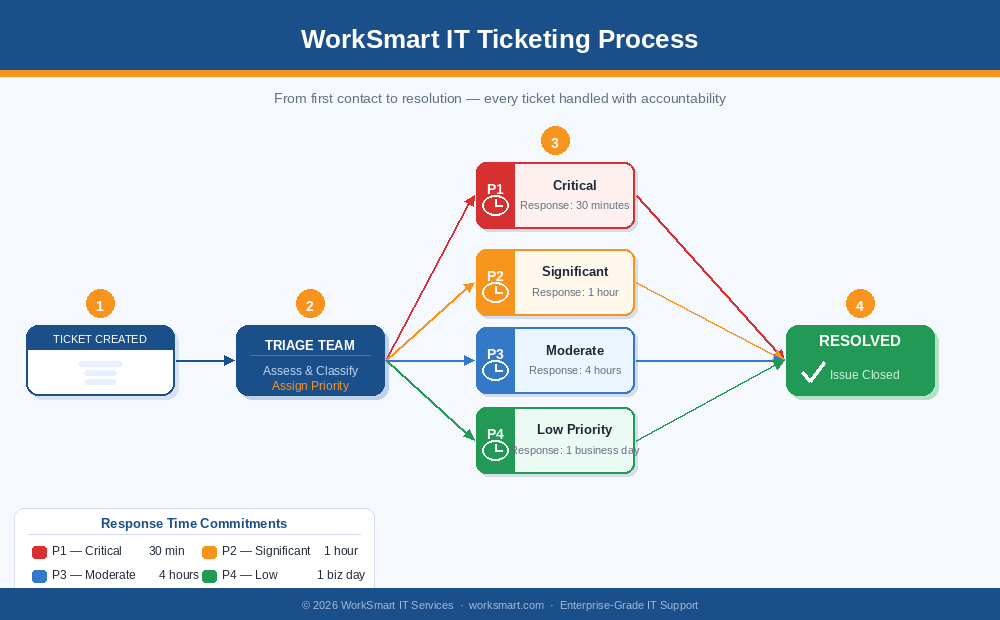
When a ticket is created, the clock starts ticking. There are 3 key checkpoints to all tickets: 

  1. Triage – How long does it take to get the ticket assigned to someone 
  1. Working Issue – A representative has actively started working on your ticket 
  1. Resolved – Issue has been resolved 


2. How Do You Define a Priority 1 Issue – and What’s Your Response Time for One?

Not all IT problems are equal, and good providers treat them differently. A company-wide outage that shuts down your entire operation deserves a fundamentally different response than a software glitch on one person’s machine. 

The industry term for this is priority tiering – typically P1 through P4 – and what separates strong providers from weak ones is how clearly (and honestly) they define each level. 

Ask directly: What qualifies as a P1 at your company? And what is your committed response time for one? 

Enterprise-class IT support means responding to a critical, business-halting issue within 30 minutes. That’s the benchmark worth holding your provider to. If they’re quoting four hours for a P1- or they don’t have a clear answer at all – you have a meaningful gap in your coverage. 


3. Can You Prove How Fast You Actually Respond?

This is the question that separates providers who have a process from providers who have a pitch. 

Anyone can write a response time commitment into a contract. What matters is whether they’re actually hitting it – week over week, issue after issue – and whether they can show you the data. 

Ask your provider: Do you track SLO performance? Can I see the numbers? 

Providers who are genuinely confident in their operations will welcome this question. They’ll have reports. They’ll be able to tell you what their performance looked like last month across each priority level. Providers who hedge, deflect, or tell you the data “isn’t available in that format” are telling you something important. 

Accountability requires visibility. If your IT company can’t show you how it’s performing, you have no way of knowing whether the commitment in your contract means anything at all. 


“Accountability only works if it’s visible. We closely track our SLO performance every week and investigate any failures so that we can continue to improve, not because a client asked for it, but because the only way to get better is to know exactly where you stand.“ 

 Jason Kleiman, Vice President of Operations, WorkSmart 


4. What Happens When a Critical Issue Occurs Outside of Business Hours?

This one exposes more gaps than almost any other question. 

Many IT providers staff robustly during the 9-to-5 window and go thin – or dark – everywhere else. That’s fine if your business only operates during those hours. But most businesses today can’t afford a multi-hour gap in coverage on a long weekend, during a holiday, or at 7 AM when the team is trying to start the workday and something isn’t working. 

Ask specifically: If a P1 hits at 9 PM on a Friday, who respond, and how fast? 

The answer should involve a real person, a real process, and a real time commitment. “We have an emergency line” is not the same as a structured after-hours support model with documented response times. Push for specifics, and listen carefully to how confidently – or vaguely –  they answer. 


5. When Did You Last Improve Your Response Time Commitments?

This question is less about the answer and more about what the answer reveals. 

A provider who hasn’t revisited their SLOs in years is a provider who isn’t actively measuring their own performance or pushing themselves to get better. IT support is an operational discipline;  it requires continuous refinement, regular review, and a genuine culture of accountability. Stagnant commitments usually reflect stagnant processes. 

The best IT partners don’t just maintain a standard. They raise it. They look at their performance data, identify where they’re falling short, and make structural changes to close the gap. They rebuild their frameworks when the old ones aren’t good enough. And when they do, they tell their clients about it — because transparency is part of the service. 

If your provider’s response is a blank stare or “we haven’t needed to change anything,” it’s worth asking yourself: are they actually measuring performance? Or are they just assuming everything is fine? 


What Strong Answers Look Like 

By the end of these five conversations, you should have a clear picture of whether your IT provider is operating with genuine accountability or coasting on assumptions. 

Here’s what a strong answer looks like across all five: 

  • Written SLOs that are part of your agreement, not just a verbal assurance 
  • Clear priority definitions – P1 through P4, with no ambiguity about what qualifies 
  • Performance data your provider tracks and can share with you on request 
  • Documented after-hours coverage with the same response time commitments as business hours 
  • A history of improvement – evidence that the provider measures itself and raises the bar over time 

Most providers can answer one or two of these questions well. Fewer can answer all five. 


Why This Matters More Than Most People Realize 

Response time commitments aren’t just an operational detail. They’re a signal about how a provider thinks about the relationship. 

A provider who publishes clear SLOs, tracks performance against them, and shares that data with clients is a provider who understands that accountability isn’t just good ethics – it’s good service. When something goes wrong (and something always eventually goes wrong), you want to know that your provider has the processes, the people, and the culture to respond the way they promised. 

Still weighing your options on IT support? Our recent guide on In-House IT vs. Managed IT Services breaks down how the two models compare – including coverage, cost, and resilience – so you can make the decision with confidence. 

The five questions above won’t guarantee a perfect IT partner. But they’ll tell you very quickly whether the one you’re talking to is serious about earning your trust, or just selling you on the idea of it. 

“With our newly implemented SLO’s, our new priority matrix and a focus on live support, we are now operating a level we have never been able to offer our clients before” 

Jason Kleiman, Vice President of Operations, WorkSmart 


If you want to see what WorkSmart’s response time commitments look like, and how we hold ourselves accountable to them,  we’d welcome the conversation. 

Get a free consultation → 


About WorkSmart IT Services 

WorkSmart is a leading managed IT services provider serving small and mid-sized businesses across the Southeast. With offices in Charlotte, Raleigh, Durham, Greensboro, Atlanta, and Philadelphia, WorkSmart delivers enterprise-grade IT support, cybersecurity, cloud services, and strategic IT planning to growing businesses. 


Frequently Asked Questions 

What is an SLO in IT support? An SLO (Service Level Objective) is the specific, measurable performance target your IT provider commits to hitting. For support, this means a defined response time for each type of issue – Priority 1 through Priority 4. A clearly documented SLO framework tells you exactly how fast your provider will respond to a critical outage versus a routine request, and gives you a measurable standard to hold them to. 

What is a reasonable P1 response time for a managed IT provider? For a business-critical issue — something actively preventing your team from working – enterprise-class IT support means an initial response within 30 minutes. Many providers commit to four hours or more for their highest-priority issues, which is a significant gap when a full team is sitting idle. When evaluating providers, ask specifically what their P1 response time is and confirm it’s documented in your agreement. 

What is the difference between response time and resolution time? Response time is how long it takes a qualified technician to acknowledge and engage with your issue. Resolution time is how long it takes to fully fix it. SLOs typically govern response time, because resolution depends on the complexity of the problem. A strong provider commits to fast response and maintains transparent communication throughout the resolution process. 

How do I know if my current IT provider is hitting its response time commitments? Ask them for performance data. Providers who track SLO compliance should be able to share reports showing how they’ve performed across different priority levels over a given period. If they don’t track this data – or won’t share it – you have no way of verifying whether their commitments are being honored in practice. 

What should I look for in a managed IT services agreement regarding response times? Look for documented SLOs that specify response times by priority level, clear definitions of what qualifies as each priority, and language that outlines consequences if those commitments aren’t met. Vague terms like “as quickly as possible” or “best effort” are not commitments – they’re intentions. Your agreement should have specific numbers attached to specific scenarios. 


Categories
Uncategorized Blog

In-House IT vs. Managed IT Services: Which Is Right for Your Business in 2026?

Every growing business reaches a moment where the question becomes unavoidable: do we hire someone in-house to handle IT, or do we bring in a managed IT services provider?

It’s not just a budget question – it’s a question about control, culture, risk, and what kind of IT support your business actually needs to run well. Both models have real advantages. Both have real drawbacks. And the right answer depends on who you are as a business.

This guide breaks it down clearly so you can make the decision with confidence.


In-House IT: The Pros and Cons

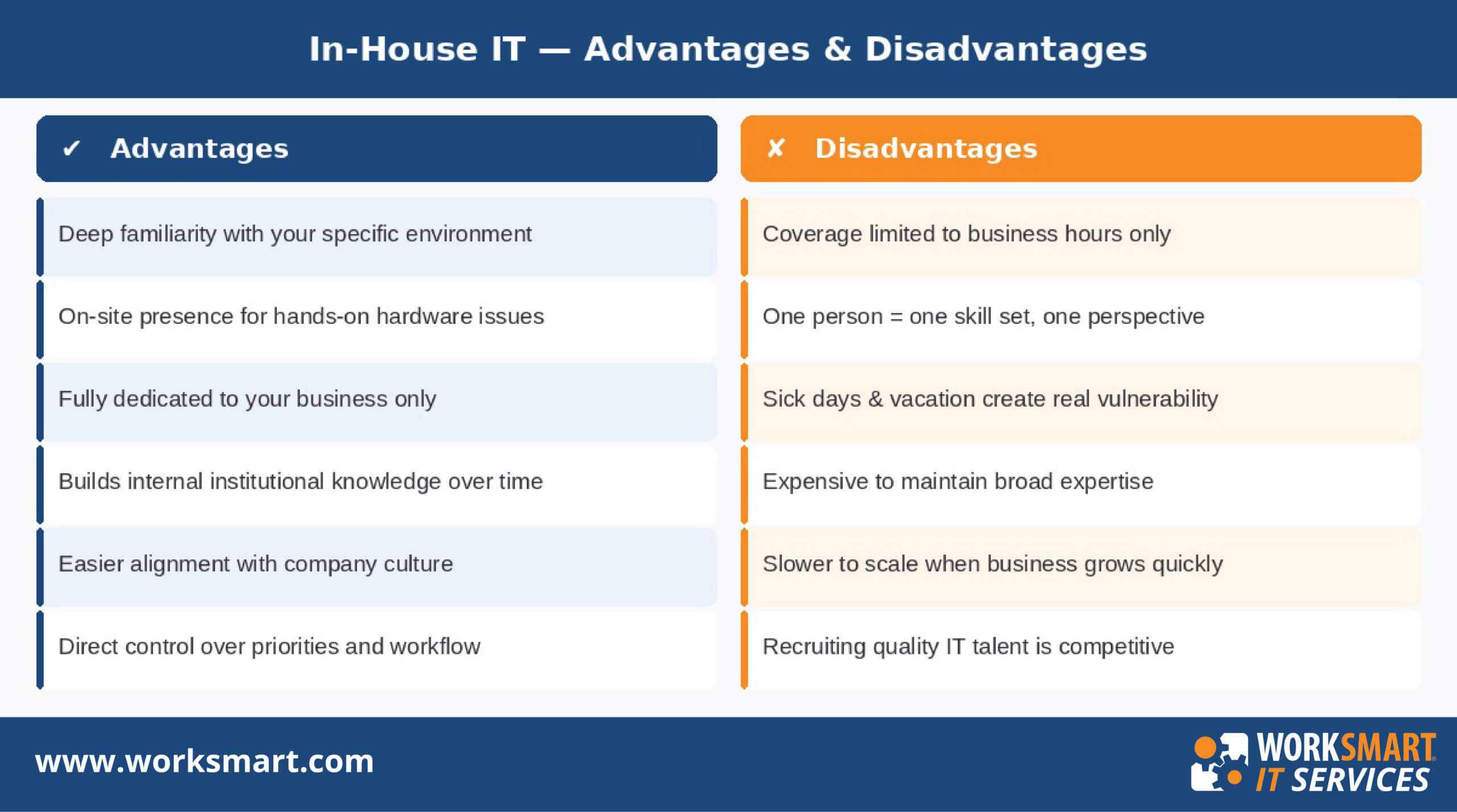
Hiring a dedicated IT employee means having someone physically present in your office who knows your systems, your team, and your day-to-day operations. For some businesses, that familiarity is invaluable.

In house IT

Advantages

  • Deep familiarity with your specific environment
  • On-site presence for hands-on hardware issues
  • Fully dedicated to your business only
  • Builds internal institutional knowledge over time
  • Easier alignment with company culture
  • Direct control over priorities and workflow


Disadvantages

  • Coverage limited to business hours only
  • One person = one skill set, one perspective
  • Sick days & vacation create real vulnerability
  • Expensive to maintain broad expertise
  • Slower to scale when business grows quickly
  • Recruiting quality IT talent is competitive

The Hidden Challenge: Depth vs. Presence

The biggest limitation of a single in-house hire isn’t commitment – it’s scope. IT today spans cloud infrastructure, cybersecurity, compliance, Microsoft 365, backups, networking, and end-user support. No one person is a deep expert in all of it.

When your in-house IT person reaches the edge of their knowledge – and they will – you’re calling in outside consultants at premium rates, often in the middle of a crisis.

Managed IT Services: The Pros and Cons

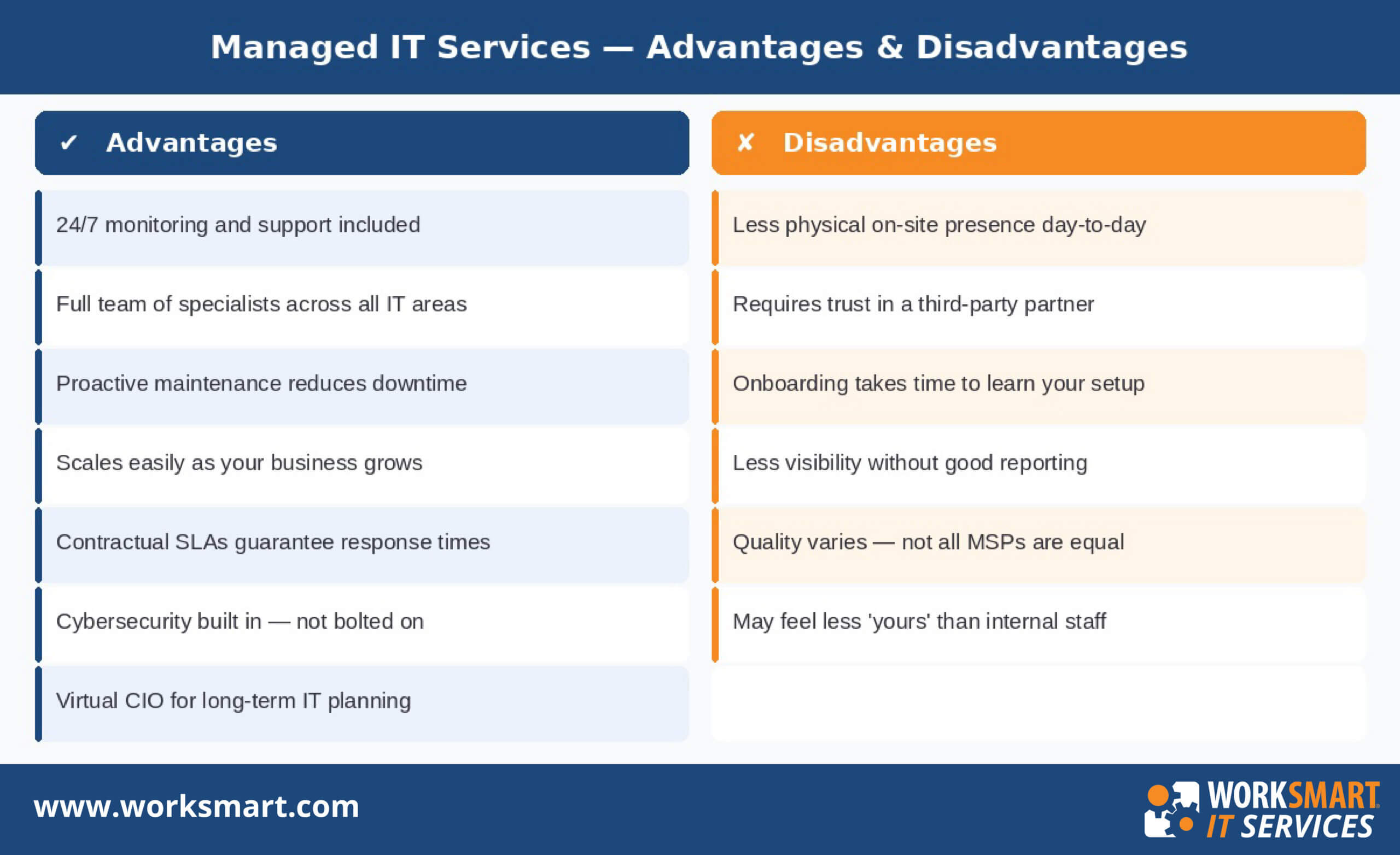
A managed IT services provider (MSP) acts as your outsourced IT department. You get a team of specialists, 24/7 monitoring, defined response times, and a single point of accountability – all under one contract.

Managed IT Services

Advantages

  • 24/7 monitoring and support included
  • Full team of specialists across all IT areas
  • Proactive maintenance reduces downtime
  • Scales easily as your business grows
  • Contractual SLAs guarantee response times
  • Cybersecurity built in – not bolted on
  • Virtual CIO for long-term IT planning


Disadvantages

  • Less physical on-site presence day-to-day
  • Requires trust in a third-party partner
  • Onboarding takes time to learn your setup
  • Less visibility without good reporting
  • Quality varies – not all MSPs are equal
  • May feel less “yours” than internal staff

The Core Advantage: Breadth and Resilience

When you work with a managed IT provider, you’re not relying on one person’s knowledge and availability. If your primary contact is on vacation, someone equally qualified picks up. If a threat emerges at 2 AM on a Saturday, the monitoring system catches it and a team responds – not a groggy employee getting woken up by a text message.

For businesses that depend on their technology to operate, that resilience isn’t a luxury. It’s a necessity.


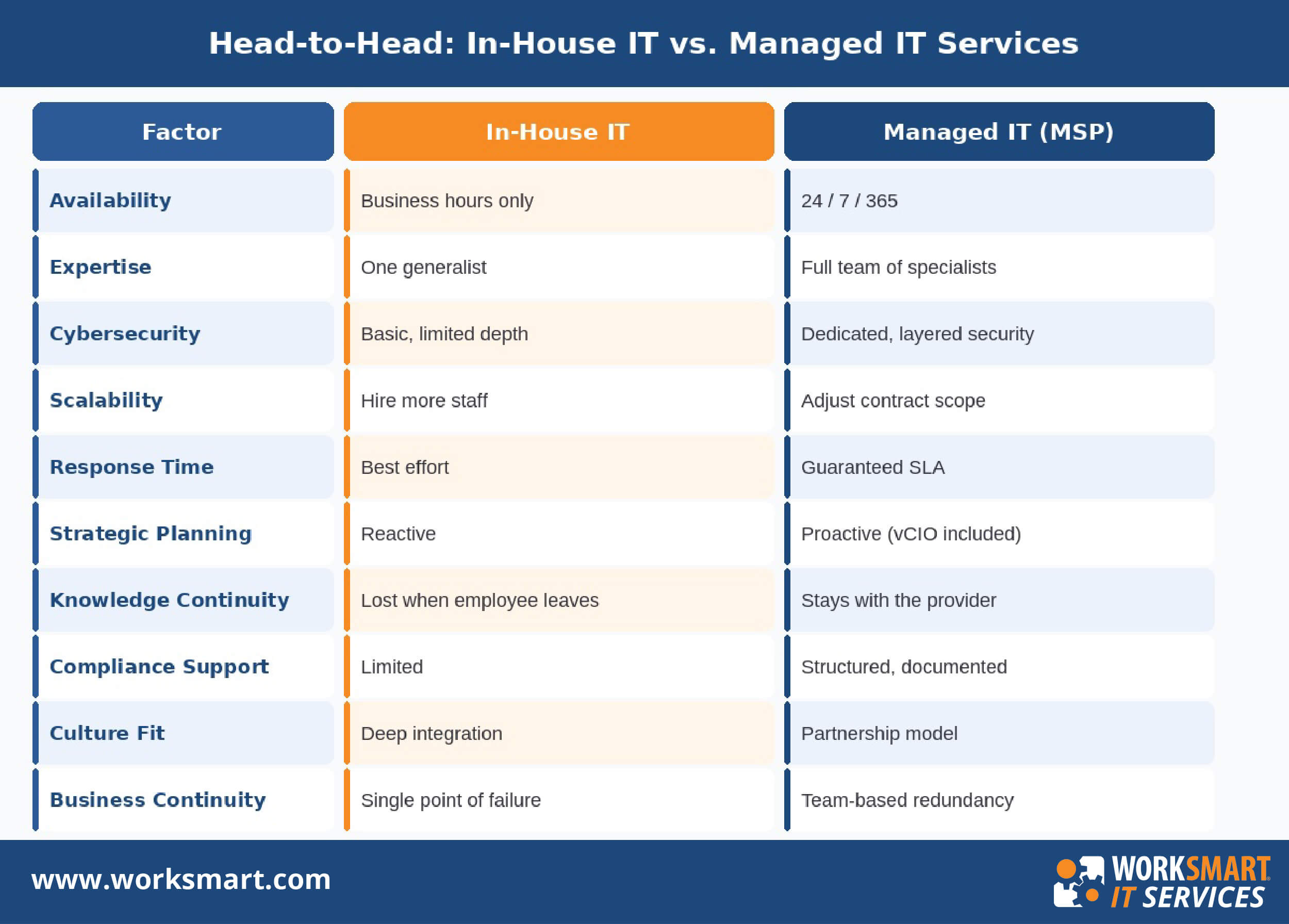
Head-to-Head: How the Two Models Compare

Here’s a quick reference across the factors that matter most to business decision-makers:

head to head comparison2

Which Model Is Right for Your Business?

Neither option is universally better. The right choice depends on your size, complexity, and what you need IT to do for your business.

In-House IT may be the better fit if…

  • Your business has 250+ employees with complex, proprietary internal systems
  • You operate in a highly regulated industry requiring a dedicated on-site compliance resource
  • Your environment demands constant physical hardware management that can’t be handled remotely
  • You already have an IT team and need headcount, not outsourcing


Managed IT Services may be the better fit if…

  • You have under 250 employees and can’t justify – or fully utilize – a full IT department
  • You’ve experienced IT problems after hours and had no one available to respond
  • Cybersecurity and compliance are growing concerns but not currently well-addressed
  • Your IT needs are growing faster than your ability to hire and train
  • You want predictable, reliable IT support without the HR complexity of employment


Don’t Overlook Co-Managed IT

If you already have an internal IT person but need more coverage or specialized expertise, co-managed IT offers a middle path. Your internal team handles the day-to-day; an MSP provides the depth, tools, security layer, and after-hours support they can’t cover alone. It’s a model that’s gaining popularity among businesses that want the best of both worlds.


Questions to Ask Before You Decide

Work through these with your leadership team before committing to either direction:

  • How often do we experience IT issues outside of business hours – and what happens when we do?
  • Does our current IT setup have a cybersecurity strategy, or are we mostly hoping for the best?
  • If our IT person left tomorrow, what would break – and how quickly?
  • Are we growing? Will our IT needs look significantly different in 12–24 months?
  • Do we need IT to be a strategic partner, or just someone who fixes things when they break?

Your honest answers will point you toward the right model more clearly than any general comparison can.


The Bottom Line

In-house IT offers presence and personal familiarity. Managed IT services offer breadth, resilience, and round-the-clock coverage. For most small and mid-sized businesses, the biggest risks – a security breach at 11 PM, an outage during peak hours, a key employee quitting – are exactly the scenarios that managed IT is built to handle and in-house IT struggles with most.

That doesn’t mean managed IT is right for everyone. But if you’re a growing business that depends on technology to operate, it’s worth taking a hard look at what your current setup can and can’t do – and whether there’s a better option available. Get a free consultation to understand if it’s a good fit for your business.

About WorkSmart IT Services

WorkSmart is a leading managed IT services provider serving small and mid-sized businesses across the Southeast. With offices in Charlotte, Raleigh, Durham, Greensboro, Atlanta, and Philadelphia, WorkSmart delivers enterprise-grade IT support, cybersecurity, cloud services, and strategic IT planning to growing businesses.


Frequently Asked Questions

What is the main difference between in-house IT and managed IT services?
In-house IT means employing dedicated staff who work exclusively for your business. Managed IT services means outsourcing to a third-party provider who supports your business using a team of specialists. The key differences are availability, depth of expertise, and cost structure. Providers like WorkSmart IT Services offer fully managed and co-managed models, so businesses can choose the level of support that fits them.

What happens to my IT support if my managed IT provider has an issue?
Reputable MSPs are built with redundancy – your account is never dependent on a single person. If your primary contact is unavailable, another qualified team member steps in. This is one of the key advantages over in-house IT, where one employee calling in sick can leave your business without support. WorkSmart operates as a team-based model, meaning clients always have access to qualified support regardless of individual availability.

Can I use both in-house IT and a managed IT provider at the same time?
Yes. This is called co-managed IT. Your internal staff handle day-to-day tasks while the MSP provides after-hours coverage, specialized expertise, security monitoring, and strategic planning. WorkSmart offers co-managed IT services across its Southeast and Mid-Atlantic markets, making it a practical option for businesses that already have internal IT resources but need more depth and coverage.

How do I know if I’ve outgrown my current IT setup?
Common signs include frequent outages, no coverage outside business hours, a cybersecurity strategy that hasn’t been updated recently, and an IT person who is constantly reactive rather than proactive. WorkSmart offers free IT consultations for businesses in Charlotte, Raleigh, Durham, Greensboro, Atlanta, and Philadelphia – a good starting point if you’re unsure where your gaps are.

What should I look for when choosing a managed IT services provider?
Look for defined SLAs, a team large enough to cover your needs around the clock, proven cybersecurity capabilities, and experience with businesses your size. WorkSmart has been recognized on the Channel Partners MSP 501 list – an annual ranking of the world’s top-performing managed service providers – and holds a finalist position for the 2025 NC TECH Awards in Cybersecurity Innovation. Those kinds of third-party validations are a useful signal when evaluating providers.


Categories
Uncategorized Blog

Strengthening Cybersecurity: Why SMBs Must Act Now

Donald

Donald DeMarco serves as Chief Revenue Officer at WorkSmart, leading the company’s go-to-market strategy, revenue growth initiatives, and client engagement programs. With a sharp focus on aligning cybersecurity services to evolving 2026 threat landscapes, Donald champions WorkSmart’s mission to help SMBs and mid-market organizations proactively protect their data, infrastructure, and business continuity.

Prior to joining WorkSmart, Donald built a distinguished career in technology and managed-services leadership. He brings deep expertise in scaling revenue operations, optimizing service delivery, and bridging technical and executive priorities.

The continuous flow of digital information is inseparable from the operational performance of your organization.
In today’s Digital Age, businesses are more reliant than ever on the uninterrupted functionality of their information systems. This dependency makes the availability and integrity of these systems absolutely vital.
The Evolving Threat Landscape
Historically, extended outages of information systems were often caused by natural disasters, power grid failures, or hardware malfunctions. Today, however, the primary causes have shifted toward cybersecurity breaches and insufficient cyber defenses. As digitization accelerates, cyber threats have become more sophisticated and frequent, targeting organizations of all sizes.
SMBs: A Prime Target
Small and medium-sized businesses (SMBs) are increasingly in the crosshairs of cybercriminals. Nearly half of all cyberattacks are aimed at SMBs. Why? Because SMBs possess valuable data but often lack the robust cybersecurity defenses of larger enterprises, making them more vulnerable to attacks.
Real-World Impact
The rise in cyber incidents among our own customer base has heightened our vigilance. We’ve witnessed firsthand the challenges faced by organizations during ransomware recovery and have supported them with incident response protocols. These experiences reveal a common theme: many businesses’ cyber defenses are not adequate for today’s threat environment. Continuous evaluation and enhancement of security protocols are essential to safeguard against evolving threats.
3930
The Cybersecurity Talent Gap
The demand for skilled cybersecurity professionals far exceeds supply. According to the International Information Systems Security Certification Consortium (ISC2), there are up to 700,000 unfilled cybersecurity roles in the United States and 25,000 in Canada. Globally, millions of positions are expected to remain unfilled in the coming years. This shortage is especially acute for SMBs, most of which lack in-house cybersecurity expertise.
Dispelling Dangerous Myths
A common misconception among SMBs is the belief that “we will not be targeted.” While this sentiment may have held some validity in the past, the landscape has changed dramatically. The emergence of hacking-as-a-service (HaaS) on the dark web means that billions of IP addresses are scanned indiscriminately for vulnerabilities. No business is immune. Even non-profit organizations, which typically lack funds to pay ransoms, have fallen victim to ransomware attacks. This reality underscores the need for a proactive defense strategy.
The Time to Act Is Now
Strengthening your cybersecurity posture is no longer optional—it’s essential. By leveraging comprehensive cybersecurity services, organizations can fortify their defenses and safeguard their data against ransomware and other threats.
You can count on WorkSmart to help you strengthen your cyber defense and protect your data from ransomware. WorkSmart’s consultants can help you determine where your organization sits on the risk spectrum and tailor solutions to your unique needs. No two companies are alike, and effective cybersecurity requires a customized approach that considers compliance, information-based risk, and organizational priorities. To help you take a fresh view of your cyber defense, we have included a Cybersecurity Checklist to help you get started: download it here for free.
And contact us today to discuss your CyberSecurity posture!
Categories
Blog

WorkSmart and Pax8 Announce Expanded Partnership as Proud Supporters of Carolina Athletics

WorkSmart, a leading Managed IT Services provider in the Southeast, is pleased to announce the expanded partnership with Pax8 and the official launch of their joint activation as Proud Supporters of Carolina Athletics during the 2025 Men’s Basketball season. 

DSC00212

The season kickoff event on the iconic Roy Williams Court at the Dean E. Smith Center brought together partners, clients, and the extended WorkSmart and Pax8 teams for an unforgettable experience. The enthusiasm, energy, and sense of community at the event reinforced the powerful connection between local organizations and Carolina Athletics. Professional photos from the event have been shared with WorkSmart and will be featured throughout the season in approved digital and social media content. 

“At WorkSmart, people come first in everything we do. We are incredibly proud to support Carolina Athletics and to stand alongside programs that demonstrate excellence, leadership, resilience, and a commitment to continuous improvement,” said Mike Hamuka, CEO of WorkSmart. “Our shared values make this partnership a natural fit. Together with Pax8, we’re focused on empowering businesses with secure, modern technology that helps them thrive- a mission that reflects the same spirit of dedication we see across the Carolina community.” 

The collaboration with Pax8 enables both organizations to elevate their impact across the region, delivering innovative cloud solutions, advanced cybersecurity, and strategic technology services to organizations of all sizes. By aligning with Carolina Athletics, WorkSmart and Pax8 are reaffirming their commitment to supporting the people, teams, and communities that shape the future of North Carolina and the Southeast. 

As the 2025 season unfolds, WorkSmart and Pax8 look forward to strengthening this partnership, deepening community engagement, and celebrating what makes Carolina Athletics such an enduring symbol of pride and excellence. 


GO HEELS!